
Blue Fire Jellyfish Article on Tal Avitzur


After earning a Masters in Maths, Tal worked for the US Navy in Washington, where he determined the best collection of spare parts that carriers should keep stocked in order to maximise readiness of planes.
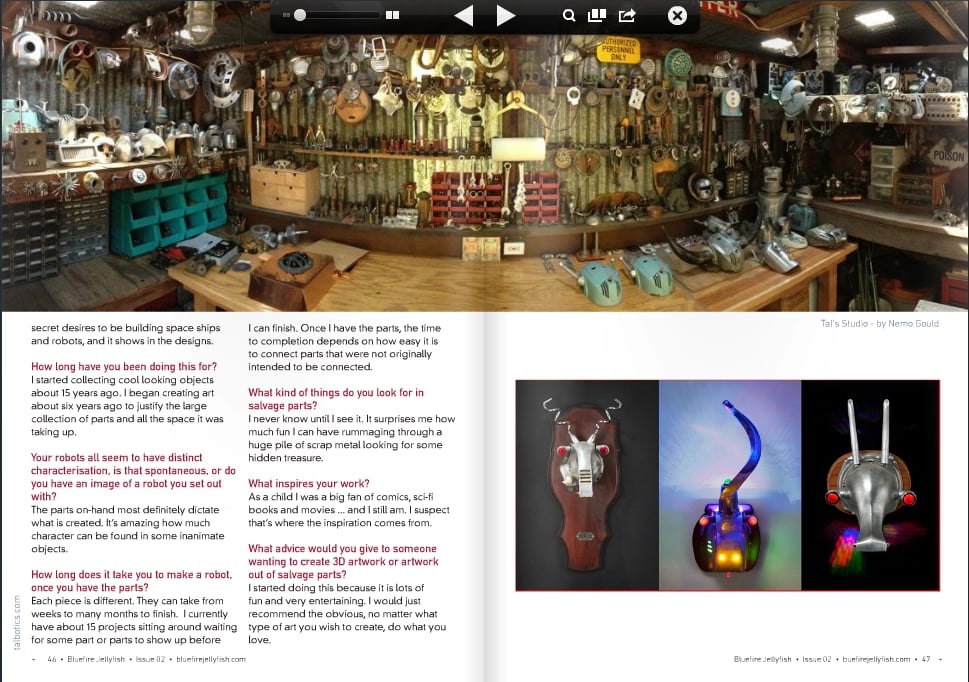
However the call of Santa Barbara was too great, and eventually Tal returned to teach part-time so he could concentrate on artistic pursuits. After a salvage for a home improvement project, and a visit to a scrap metal yard, Tal sealed his fate. Here we chat to Tal about his robots and how they come to life.
Describe the process of putting these robots together, how do the ideas start and how do you put them together?
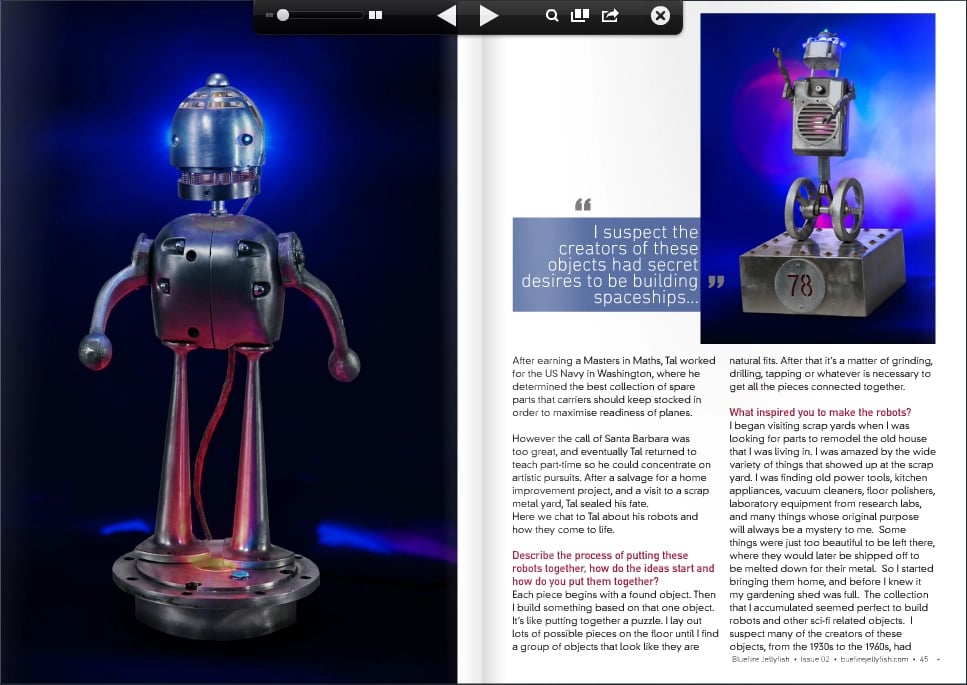
Each piece begins with a found object. Then I build something based on that one object. It’s like putting together a puzzle. I lay out lots of possible pieces on the floor until I find a group of objects that look like they are natural fits. After that it’s a matter of grinding, drilling, tapping or whatever is necessary to get all the pieces connected together.
What inspired you to make the robots?
I began visiting scrap yards when I was looking for parts to remodel the old house that I was living in. I was amazed by the wide variety of things that showed up at the scrap yard. I was finding old power tools, kitchen appliances, vacuum cleaners, floor polishers, laboratory equipment from research labs, and many things whose original purpose will always be a mystery to me. Some things were just too beautiful to be left there, where they would later be shipped off to be melted down for their metal. So I started bringing them home, and before I knew it my gardening shed was full. The collection that I accumulated seemed perfect to build robots and other sci-fi related objects. I suspect many of the creators of these objects, from the 1930s to the 1960s, had secret desires to be building space ships and robots, and it shows in the designs.
How long have you been doing this for?
I started collecting cool looking objects about 15 years ago. I began creating art about six years ago to justify the large collection of parts and all the space it was taking up.
Your robots all seem to have distinct characterisation, is that spontaneous, or do you have an image of a robot you set out with?
The parts on-hand most definitely dictate what is created. It’s amazing how much character can be found in some inanimate objects.
How long does it take you to make a robot, once you have the parts?
Each piece is different. They can take from weeks to many months to finish. I currently have about 15 projects sitting around waiting for some part or parts to show up before I can finish. Once I have the parts, the time to completion depends on how easy it is to connect parts that were not originally intended to be connected.
What kind of things do you look for in salvage parts?
I never know until I see it. It surprises me how much fun I can have rummaging through a huge pile of scrap metal looking for some hidden treasure.
What inspires your work?
As a child I was a big fan of comics, sci-fi books and movies ... and I still am. I suspect that’s where the inspiration comes from.
What advice would you give to someone wanting to create 3D artwork or artwork out of salvage parts?
I started doing this because it is lots of fun and very entertaining. I would just recommend the obvious, no matter what type of art you wish to create, do what you love.
Text from Article About Tal Avitzur in August 5, 2014 Issue of Blue Fire Jellyfish
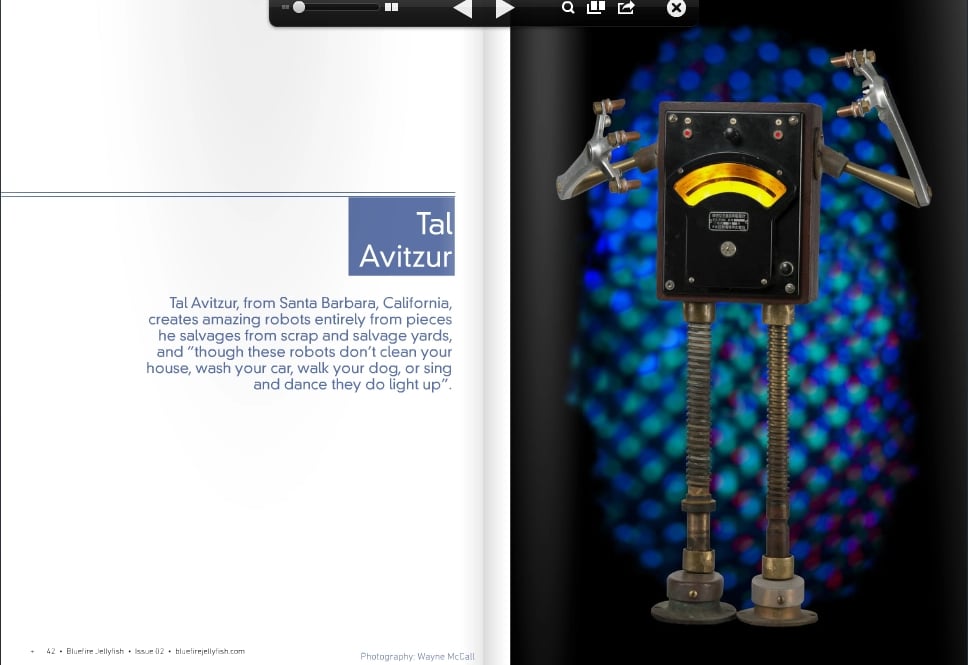
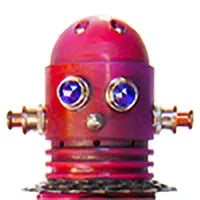
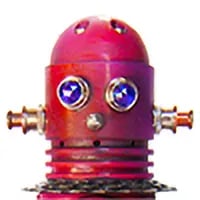
Tal Avitzur, from Santa Barbara, California, creates amazing robots entirely from pieces he salvages from scrap and salvage yards, and “though these robots don’t clean your house, wash your car, walk your dog, or sing and dance they do light up”.
Talbotics Sculpture Studio • Tal Avitzur
3945 Calle Cita, Santa Barbara, CA 93110
805-324-3991 • tal@talbotics.com
All images on this website are copyrighted by the artist, © Tal Avitzur, 2026.
If you use any image from this site for your blog or website please credit the artist and link back to this site.
If you would like to use any image or content from this site for commercial purposes, please email for licensing requests.